Seasonal Closet Swap Checklist for Small Apartments
October 13, 2026 - Organization


October 13, 2026 - Organization

October 12, 2026 - Packing

October 09, 2026 - Decluttering

October 08, 2026 - Home Spaces
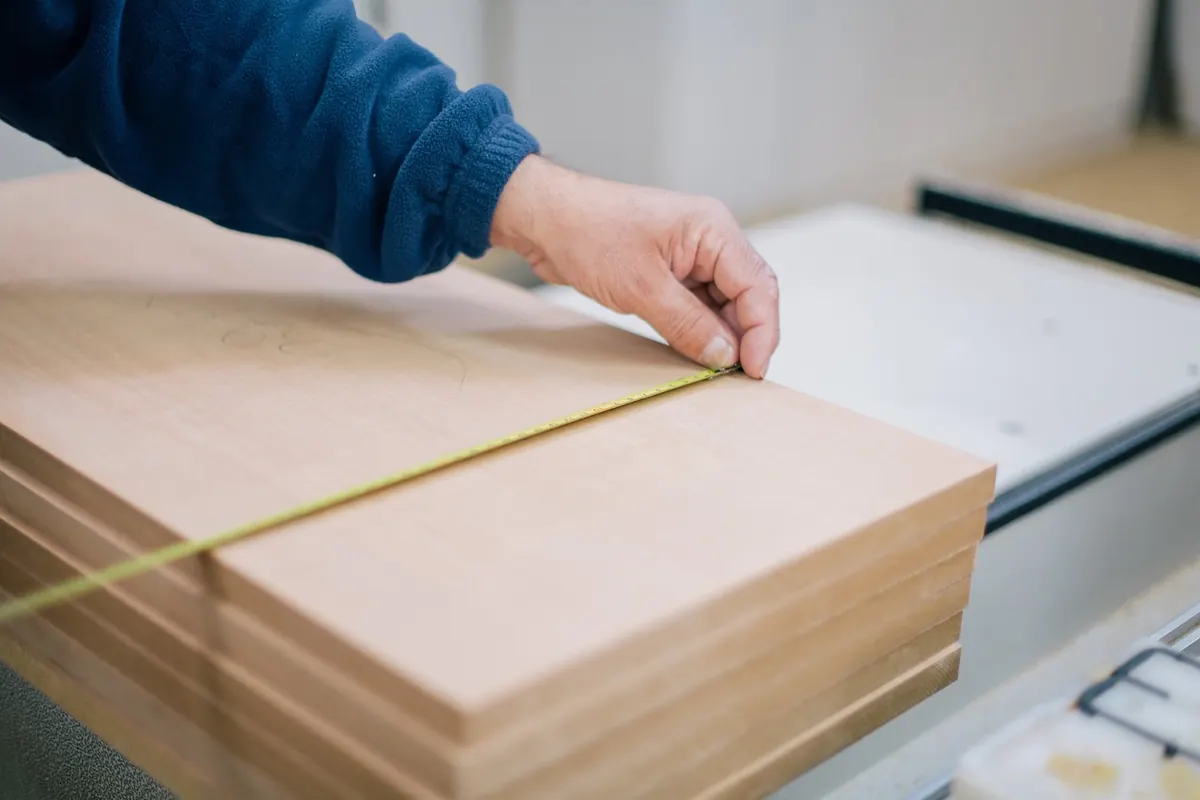
Most storage bins fail for one of two reasons. They are a hair too wide, so they wedge into the closet and never come out without a fight. Or they are so much smaller than the space that a third of every shelf goes to dead air. Both problems start with shopping before measuring. Ten minutes with a tape measure and a pencil will save you a return trip and a shelf full of gaps.
You can measure around a rack of coats, but the numbers will lie to you. Clear one section at a time. What you need is not the size of the closet so much as the shape of the space that is genuinely available once the fixed parts are accounted for.
Walk the closet with a flashlight and note every obstacle: baseboards, door frames, hinges, shelf brackets, the hanging rod, an outlet, a pipe boxed in at the back, a sloped ceiling. These are the things that turn a 24-inch shelf into a 21-inch shelf. Write them down now so you do not rediscover them in the aisle at the store.
If you have shelves you are not moving, measure the actual gap between them rather than assuming standard spacing. Builders use standard dimensions, but closets age, and a previous owner may have added a shelf exactly where you want a bin. Emptying one shelf at a time also gives you a chance to sort: keep, relocate, donate. You may find that two bins are enough, not six.
Width is the number people get wrong, because a closet is rarely the same width at the top and the bottom. Drywall corners are not square, frames settle, and old houses move. Measure in three places and keep the smallest:
The smallest of the three is your true width. If bins will sit side by side along a shelf, subtract anything that intrudes — a hinge, a bracket, the track of a sliding door — then take off a working allowance. A quarter inch total on small bins, about half an inch on larger ones. Bins should slide in and out, not press-fit like a drawer.
For example, suppose the back wall measures 36 inches at the floor, 35 3/4 inches at waist height, and 35 1/2 inches under the header. Your true width is 35 1/2 inches. If a door hinge eats 1 inch, you have 34 1/2 inches. A pair of 17-inch bins would total 34 inches and likely jam. A pair of 16-inch bins gives you 32 inches with room to spare. This is why product labels are not enough. Nominal bin sizes often include a rim or handle that adds a fraction.
Depth is the measurement people skip, and it is the one that ruins an otherwise good purchase. Measure front to back at the top, middle, and bottom, on both the left and right side of the closet. Use the smallest figure. A boxed pipe, an outlet, or a bracket at one end can cut two inches of depth on that side alone.
Then think about the door. A bin has to leave the closet to be useful. With swinging or bifold doors, measure from the front edge of the shelf to the door and check that the bin clears the frame on its way out. A bin that fills the depth perfectly but catches on a door frame is one you will curse every week.
If clothes hang nearby, the rod and the hangers take depth too. Measure to the front edge of a hanger, not to the wall, and treat that as your real depth. A shelf that measures 16 inches deep on the left and 14 inches deep on the right because of a pipe means your safe depth is 14 inches. A 15-inch bin might fit on the left but will hit the pipe on the right. Use 14 as your maximum, then subtract a half inch for breathing room.
Usable height is the distance from the surface the bin sits on to the underside of whatever is above it — the next shelf, the rod, the header, the ceiling. Measure at the left, center, and right, because shelves sag and old houses are uneven. Keep the smallest number.
Then subtract clearance for your hand. If you need to lift a bin out, you need enough height to clear the rim plus a few fingers. For lidded bins, measure the bin with the lid on. A bin that is 11 inches tall under a 12-inch shelf sounds fine until you try to slide a lid off or lift it out. For stacking, multiply: two 10-inch bins need at least 20 inches of clear height, plus an inch or two for getting them in and out.
If you are measuring under a hanging rod, remember that the rod itself and the hangers take space. Measure from the shelf to the lowest point of the hangers, not to the rod. If the hangers swing, leave an extra inch. A bin that clears a still hanger may not clear one that has been pushed to the side.
A bin has to enter, exit, and be opened. Measure the closet opening at its narrowest point: between the door frame and the opposite jamb, between hinges, or between the edges of a bifold. Then measure the shelf depth from front edge to back wall. If the shelf is 15 inches deep and the opening is 24 inches wide, a 15-inch-deep bin will fit on the shelf but may not turn easily through the door. Rectangular bins often need diagonal clearance.
Also check door swing. A swinging door may clear the shelf when open but block access when closed. Bifold doors need clearance at the sides. Sliding doors mean one side is always blocked. In that case, place bins you use daily on the accessible side and long-term storage on the other. If the bin is wide, measure the diagonal of the closet opening. You can test with a piece of cardboard cut to the bin’s footprint. It sounds fussy, but it takes two minutes and prevents wrestling.
Now reduce your numbers to a safe range rather than a single ideal measurement. Use this rule of thumb:
Write the range on a note and take it with you. For example: “Width 34 to 34 1/2, depth 13 1/2 to 14, height under 10.” Then read product dimensions, not just the listed capacity. A 50-quart bin from one brand may be 22 inches long and 16 inches wide; another may be 24 inches long and 15 inches wide. Capacity tells you volume, not fit. Look for the exterior dimensions, including handles and lids.
If bins will sit side by side, do the math for the group. Three bins at 11 1/2 inches wide equal 34 1/2 inches. If your safe width is 34 inches, they will not fit, even if each bin individually would. Round down, not up. It is better to have a half-inch of breathing room than a half-inch of scrape.
Say your reach-in closet has a back wall that measures 60 inches at the floor and 59 1/2 inches under the top shelf. A door hinge intrudes 3/4 inch on the left. There is a pipe boxed in at the back right, so the shelf is 15 inches deep on the left and 13 inches deep on the right. The clear height between shelves is 12 inches. Your safe width is 59 1/2 minus 3/4, or 58 3/4 inches; round down to 58 1/2. Your safe depth is 13 inches minus 1/2, or 12 1/2. Your safe height is 12 inches minus 1 1/2 for lifting, or 10 1/2. That points to bins around 12 inches deep, 10 inches tall, and either 14 or 19 inches wide, depending on how you want to divide the shelf. Four 14-inch bins would total 56 inches, leaving 2 1/2 inches for fingers and wobble. Three 19-inch bins would total 57 inches, which is too tight. The numbers make the choice for you.
Before buying six matching bins, make one cardboard template. Cut a rectangle to the bin’s advertised exterior footprint, then slide it onto the shelf at the tightest point. Try it under the lowest obstacle, behind the door frame, and at the back corner. If it catches, trim the template and try again. This is especially useful for wire shelving, where the lip of the shelf reduces usable depth, and for closets with angled walls.
If the template fits with a little room, buy one bin first. Load it, carry it to the closet, and take it in and out five times. If it passes, buy the rest. If it does not, you have lost a single trip instead of a carload. Finally, label your measurements inside the closet door with painter’s tape. Future you will forget why the left side is shallower, and the next bin purchase will be easier.
Measuring a closet is not about finding the biggest bin that fits. It is about finding the bin that fits the way you actually use the space. Measure the smallest width, the smallest depth, and the clear height. Subtract for hinges, hangers, doors, and hands. Write it down. Then shop with those numbers in your pocket. The result is a closet where bins slide out easily, nothing goes to dead air, and you never have to wrestle a plastic box out of a too-tight shelf again.
Photo: JulioMuebles / Pixabay
A step-by-step seasonal closet swap for small apartments: timing the switch, sorting and packing off-season clothes,...
An eight-week moving-day packing timeline that breaks sorting, boxing, labeling, and last-minute essentials into...
October 13, 2026 - Organization
October 12, 2026 - Packing
October 09, 2026 - Decluttering
Copyright © 2026 The Stow Guide. All Right Reserved.